Why Grocery Checkout Can Cost More Than the Recipe Estimate
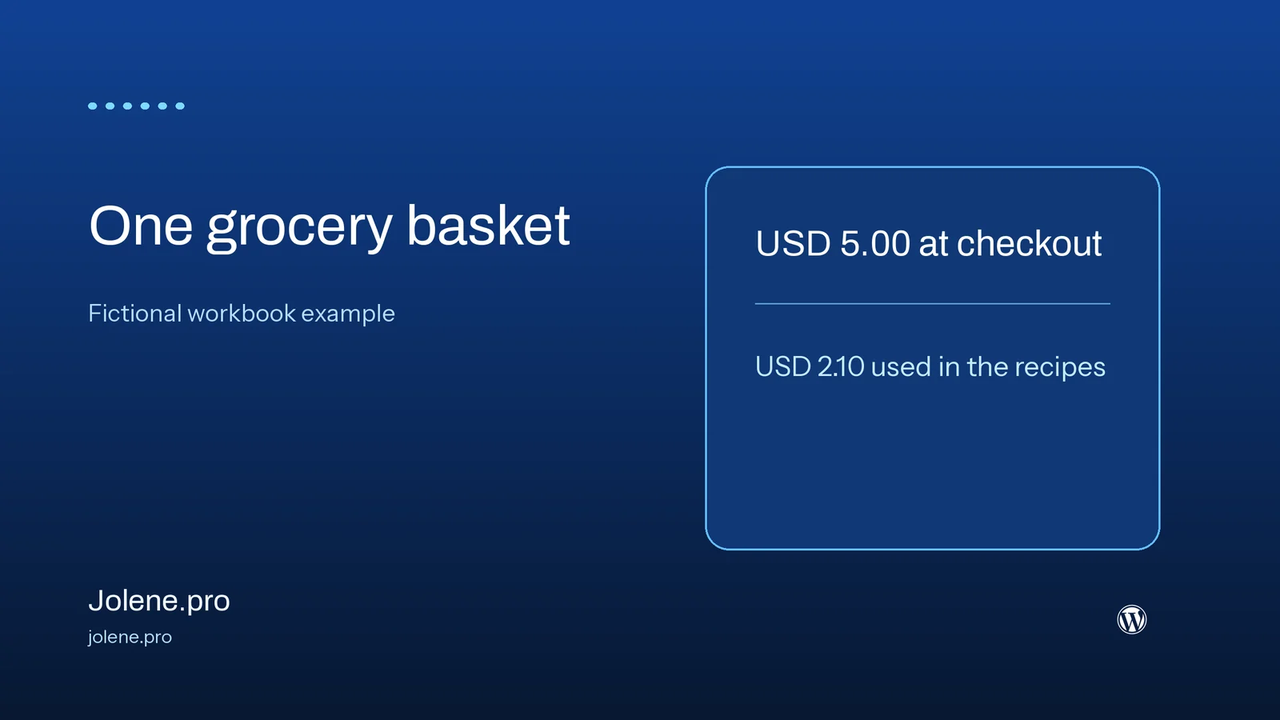
If the recipe needs 600 g of rice and the store sells it by the kilogram, you still buy a whole pack. In this fictional basket, the checkout is USD 5.00. The amount used in the recipes is worth USD 2.10 at those same pack prices.
Combine recipe quantities before rounding to packs
This example uses fictional records.
| Ingredient | Combined need (g) | Usable pantry stock (g) | Pack size (g) | Pack price (USD) | Packs to buy |
|---|---|---|---|---|---|
| Rice | 600 | 0 | 1000 | 2 | 1 |
| Spice | 30 | 0 | 100 | 3 | 1 |
- Put every quantity for each ingredient in the same unit. Here 0.2 kg plus 400 g is 600 g. In Need!A2:C4 keep both rice rows and the separate spice row so you can trace the totals.
- For each ingredient, subtract the usable pantry count and floor the result at zero. Divide by pack size and round up once, after combining all recipes. In Excel the calculation is =ROUNDUP(MAX(0,B2-C2)/D2,0) when need, stock and pack size are numeric and use the same unit.
- Compute checkout separately from use. Each pack costs USD 2 or USD 3, so checkout is USD 5. At the same unit prices, 600 g of rice is worth USD 1.20 and 30 g of spice is worth USD 0.90. The leftover purchased contents represent USD 2.90.
With 400 g of rice on hand, you need 200 g more and still need one 1,000 g pack. Keep missing size or conversion data in an exception list. The example uses one pack option per ingredient and excludes delivery, substitutions and taxes.
References and related examples
Try it in Jolene.pro with a spreadsheet you are authorized to use.