Jolene.pro for Freight Forwarders: Review Freight Invoices Before Payment
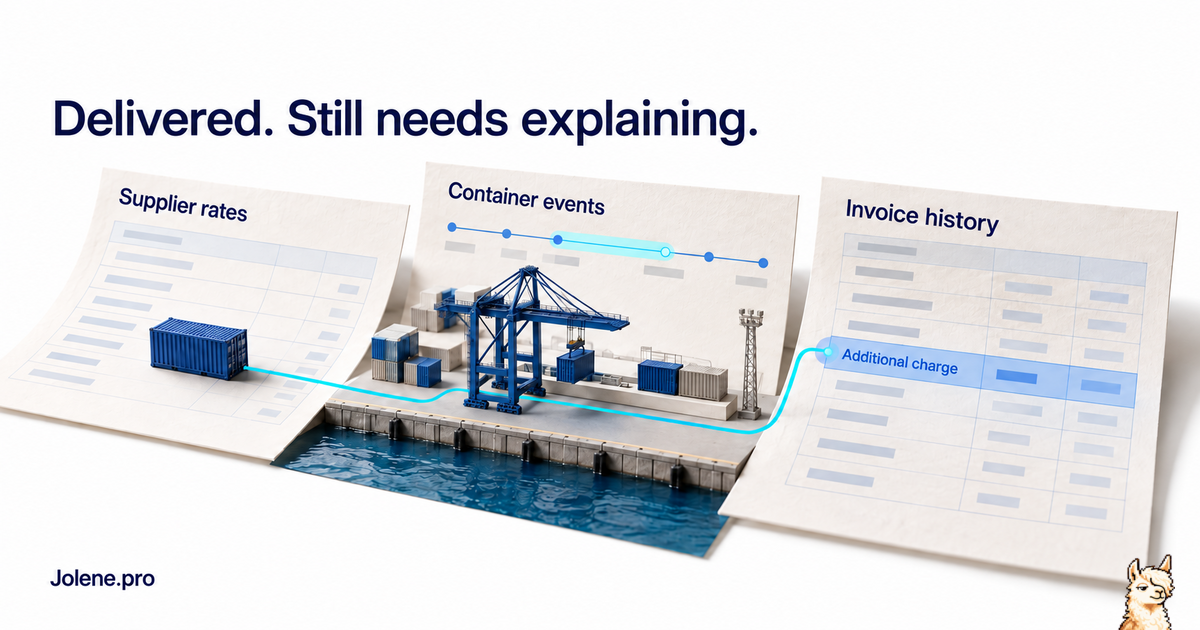
A supplier invoice arrives for a shipment that has already been delivered. The total is higher than expected.
For a freight forwarder’s finance team, the next step is to establish which charges match the agreement, which reflect additional services, and which need an explanation.
Jolene.pro helps teams examine that question across Excel and CSV records, with references to the source cells, rows and sheets. The useful work comes from connecting supplier rates, shipment events and invoice history around the same shipment.
Give each charge its own explanation
Consider a fictional container shipment with a supplier invoice totaling $4,850.
The invoice includes $3,500 in ocean freight, $650 in terminal handling, $450 in detention and $250 in documentation charges.
The supplier’s booking-specific rate confirmation supports the first two amounts. Detention needs checking against the applicable free time and container events. The documentation charge resembles a $250 line on an earlier invoice.
The total alone cannot resolve either question.
The container has finished its journey. The paperwork has booked a connection.
Bring the relevant records together
Prepare a workbook containing the supplier rate confirmation or rate schedule, current invoice lines, shipment milestones, and previous invoices and credits.
Use the supplier’s agreed buying rates. The amount quoted to your customer serves a different purpose.
Keep shipment and booking references, bill-of-lading numbers, container numbers, charge codes, currencies and invoice-line IDs. Preserve rate validity dates and charging units, such as per container or per shipment.
Those details prevent a plausible but incorrect match. Two invoices mentioning the same container might cover different services or periods.
Check the charge against the event
For the $450 detention line, investigate the dates and terms that produced it.
Suppose the applicable agreement allows five free days and charges $150 for each subsequent chargeable day. The invoice bills three days. Your operational records appear to support two under that agreement’s counting rules.
That creates a $150 discrepancy to investigate, not a confirmed saving.
Check the last free date, actual empty-return event and any approved extension. Confirm the calendar and start/end-day rules before calculating.
Maersk’s support documentation, for example, explains that authorized parties can view shipment-specific free days and last free dates, alongside pickup and return locations. These are useful records to obtain before challenging a charge. Maersk
For the documentation fee, compare the supplier, shipment, service and prior invoice status. A repeated amount could be a duplicate, a replacement following a credit, or a separate valid service.
Use Jolene.pro to prepare the review
With the relevant terms recorded in the workbook, try:
Review these supplier invoice lines against the applicable buying rates, shipment events and invoice history. Identify rate differences, unsupported charging periods and possible repeated charges. Account for credits and replacement invoices. Show the supporting source references and flag missing evidence rather than assuming a charge is wrong.
Jolene.pro’s source references help the reviewer move from a flagged amount to the records behind it. Its role is to support the investigation, while the team confirms the agreement and supporting documents.
The resulting follow-up becomes specific: “Please explain the third detention day” or “Does this documentation line replace the earlier invoice?”
That is more actionable than “Your total looks high.” Maersk’s invoice-dispute guidance likewise asks customers to provide supporting evidence. Maersk
Save the analysis to repeat with the next invoice batch, checking updated rates and workbook changes. Record confirmed corrections and follow the supplier’s payment and dispute process.
Try Jolene.pro with one shipment’s review workbook. Connect the charges to their rates, events and history, then take a documented question to the supplier.