Check which pending repairs still need a confirmed part referral
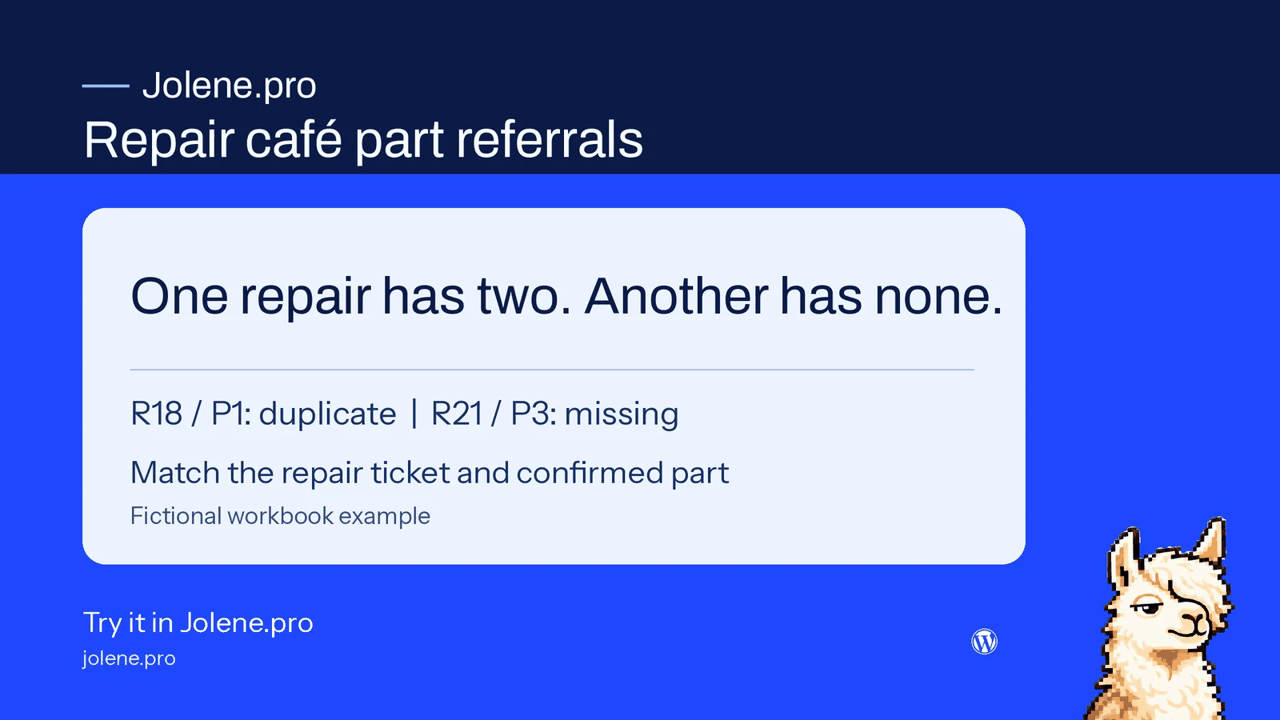
At the end of a repair session, compare the Pending list with the part recommendations actually handed to visitors. Match the local repair ticket and the confirmed part identifier together. A part used on two different repairs is two separate handoffs.
Start with the group’s existing Pending records
A Restarters discussion describes volunteers researching a part with a visitor, keeping the repair pending, and leaving the visitor to source the part. That is the workflow this check addresses. It does not assume the group buys parts or manages a warehouse. A digital list may support the handoff, while the local ticket keeps the referral attached to the correct repair.
Choose one event or review cutoff. Retain the local ticket, a confirmed part reference and a recorded handoff status. If a repair needs several parts, use one row per confirmed ticket-and-part pair. Keep alternatives or uncertain compatibility in a separate review state. The fixture below assumes one referral is expected for each listed pair.
A fictional closeout with two clean matches
| Ticket | Confirmed part | Handoff count | Review |
|---|---|---|---|
| R18 | P1 | 2 | Duplicate |
| R19 | P1 | 1 | Matched |
| R20 | P2 | 1 | Matched |
| R21 | P3 | 0 | Missing |
| R22 | P4 | 1 | No pending record |
| R23 | Blank | 0 | Hold blank part ID |
Repair Pending!A2:B5 lists R18/P1, R19/P1, R20/P2 and R21/P3. Repair Handoff!A2:B7 contains R18/P1 twice, the clean R19 and R20 pairs, R22/P4 and an R23 row with no part ID. R19 and R20 are the two clean matches. R18 and R19 share P1 legitimately because their tickets differ.
Check each expected pair, then look for extras
=COUNTIFS('Repair Handoff'!$A$2:$A$7,A2,'Repair Handoff'!$B$2:$B$7,B2)Place the pending ticket in A2 and confirmed part in B2. Applied to the four pending pairs, the formula returns 2, 1, 1 and 0. Treat blank or unconfirmed part references as held before using the match. A blank part row is not a confirmed referral even though it exists in the handoff file.
- Check duplicate ticket-and-part pairs on Pending so an accidental second expectation does not mask a second handoff.
- Count confirmed handoffs for each expected pair. List zero and more-than-one counts separately.
- Check the reverse direction for handoff pairs absent from Pending. R22/P4 needs review rather than being added automatically.
- Read the two R18/P1 source rows before deciding whether they are duplicate records, a corrected referral or an intentional second communication.
- Assign the unresolved referral to the appropriate volunteer and retain the confirmed part reference with the ticket. Keep visitor contact details out of any public example.
Close the handoff without claiming the repair is finished
A confirmed referral records that the part information was handed over. It does not mean the part was ordered, is compatible, has arrived, or fixed the item. Keep those later milestones separate. In this example, Repair Handoff!A2:B3 supports the R18 duplicate; Repair Pending!A5:B5 supports the missing R21 referral. These synthetic results were independently checked. This exact workflow has not been verified live in Jolene.pro.
Try it in Jolene.pro. Ask which pending ticket-and-part pairs lack one confirmed handoff, and request the source rows for duplicates and extras.
Source and verification
The Restarters Community discussion about digital spare-parts lists, reviewed November 26, 2026. The source explains the existing workflow. All worked records and results above are fictional.