Did release metadata enrichment keep every Discogs listing?
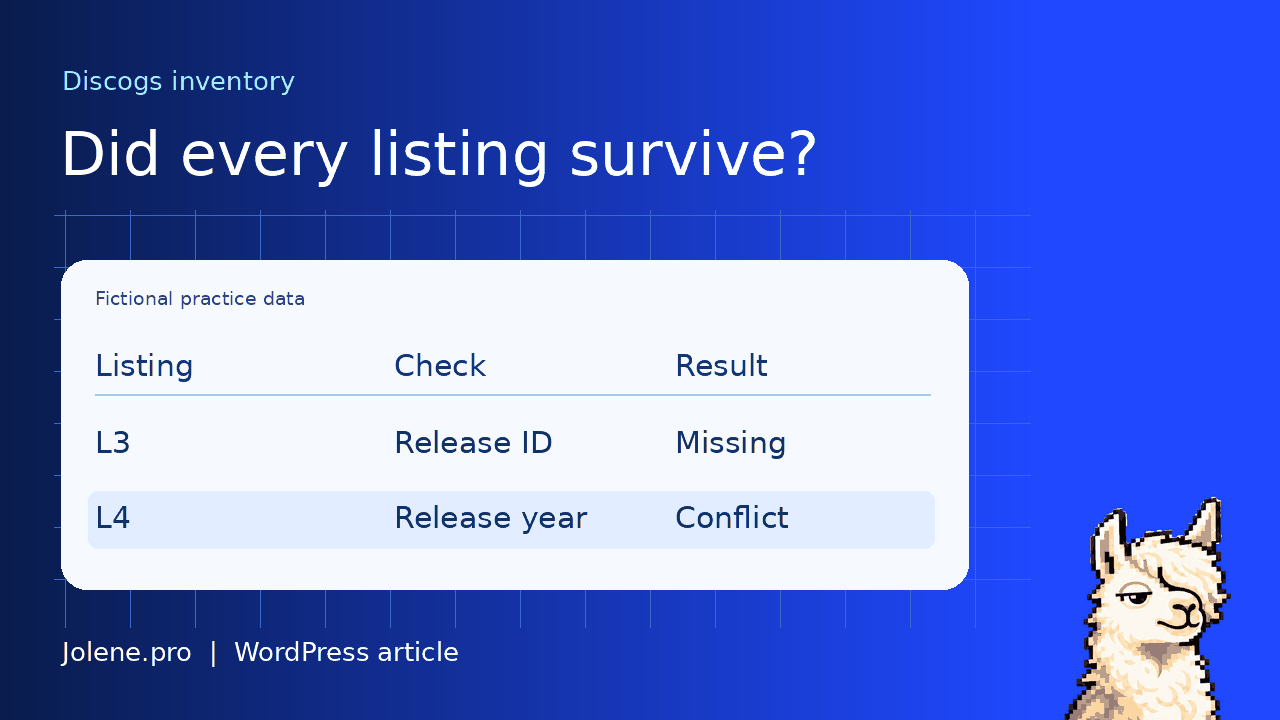
Check the metadata by release ID before joining it to the inventory. Preserve one row per original listing ID. In this fictional example, four listings remain, with two covered by consistent metadata, one missing a result and one with conflicting years.
This example uses fictional records checked independently. A live Jolene.pro result has not been verified.
Records to keep
Listings
| listing_id | release_id | grade |
|---|---|---|
| L1 | R1 | VG+ |
| L2 | R1 | NM |
| L3 | R2 | VG |
| L4 | R3 | NM |
Metadata
| release_id | year | genre |
|---|---|---|
| R1 | 1999 | Rock |
| R1 | 1999 | Rock |
| R3 | 2000 | Jazz |
| R3 | 2001 | Jazz |
How to check
Retain the inventory export unchanged. Create a separate metadata table with release ID and the requested fields. Collapse identical metadata responses for comparison while keeping their source rows. If a release ID has conflicting values, keep that listing unresolved. Join only unambiguous metadata and preserve every listing row and condition.
Worked fictional result
Listings!A2:C5 contains L1 through L4. L1 and L2 share release R1 but keep their different VG+ and NM grades. Identical R1 metadata rows at Metadata!A2:C3 support 1999. R2 has no metadata row. R3 has 2000 and 2001 in Metadata!B4:B5, so L4 remains unresolved. Two metadata responses for R1 must not double the inventory rows.
Supporting formula
=COUNTIF(Metadata!$A$2:$A$5,B2)This presence check in Listings!D2 returns 2, 2, 0 and 2. It does not decide whether repeated metadata rows agree. Compare the distinct requested field values before returning a year or genre.
When to review
Use the exact release ID, with a confirmed listing or local row key. Preserve missing metadata as blank or unresolved. An ambiguous title or different pressing requires separate verification. This is a read-only audit of copied records. No behavior of the demonstrated enrichment app was independently tested.