Why does a Lichess Swiss total exceed the played-game points?
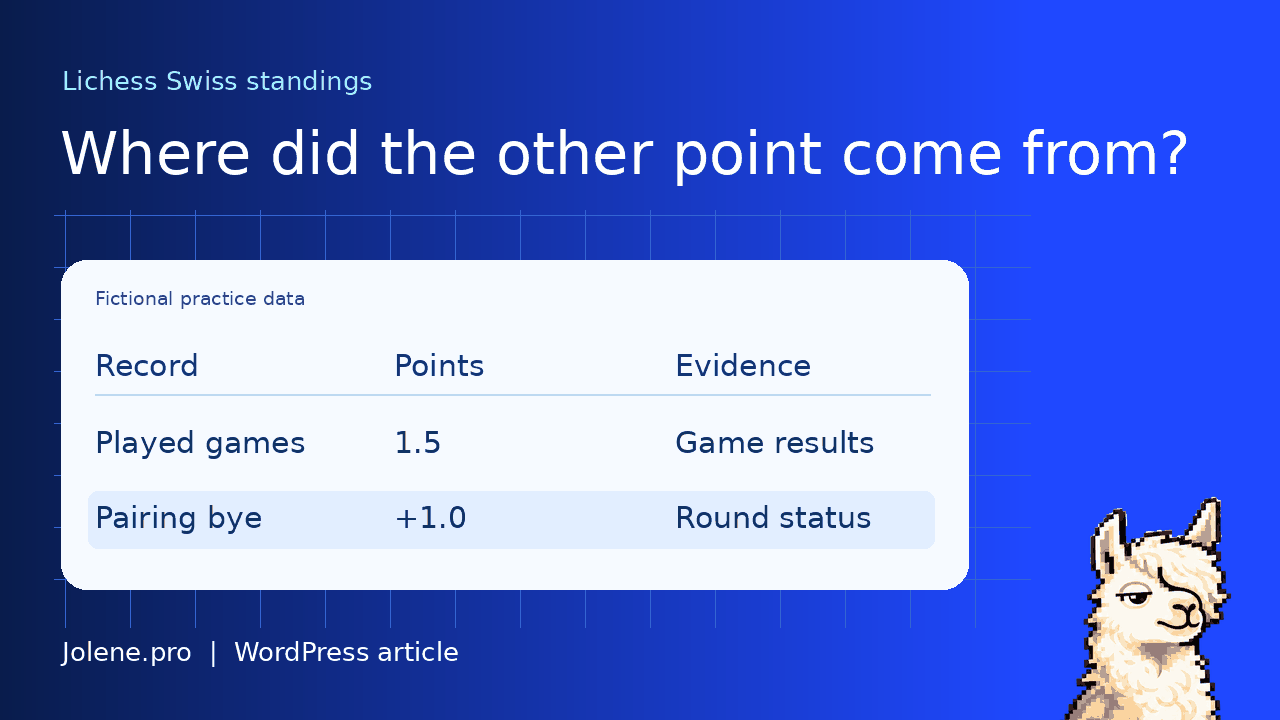
Add the recorded points from played games and supported non-game credits. In the fictional example, two games total 1.5 points and one recorded pairing bye contributes 1, explaining the 2.5-point standings total.
This example uses fictional records checked independently. A live Jolene.pro result has not been verified.
Records to keep
Games
| game_id | points |
|---|---|
| G1 | 1 |
| G3 | 0.5 |
Rounds
| round_id | status | game_id | points |
|---|---|---|---|
| R1 | played | G1 | 1 |
| R2 | pairing bye | 1 | |
| R3 | played | G3 | 0.5 |
Standings
| player_id | points |
|---|---|
| P1 | 2.5 |
How to check
Capture the standings, round statuses and game list for the same player, event and cutoff. Keep round ID, status, game ID and awarded points in separate columns. Match played rounds to the exact game IDs. Review non-game credits against the event rules and recorded status. Keep missing game evidence separate from supported bye points.
Worked fictional result
Games!B2:B3 totals 1.5. Rounds!A3:D3 records the R2 pairing bye worth 1. Standings!B2 is 2.5. Removing G3 from the practice game capture leaves R3 without its played-game evidence. R2 remains explained by its recorded bye. Tie breaks need their own data.
Supporting formula
=SUM(Games!B2:B3)+SUMIF(Rounds!B2:B4,"pairing bye",Rounds!D2:D4)This gives 2.5 for the complete fictional fixture. A real review must also check every played round against the game list and investigate any missing, repeated or conflicting game ID.
When to review
Lichess documents a one-point unpaired-round bye and a half-point late-join bye. Capture those statuses explicitly before applying weights. Keep a withdrawal or unknown status unresolved until the event evidence supports its treatment. This method reconciles supplied records and provides no engine analysis.