Why did a material cost USD 20 more than the BOM estimate?
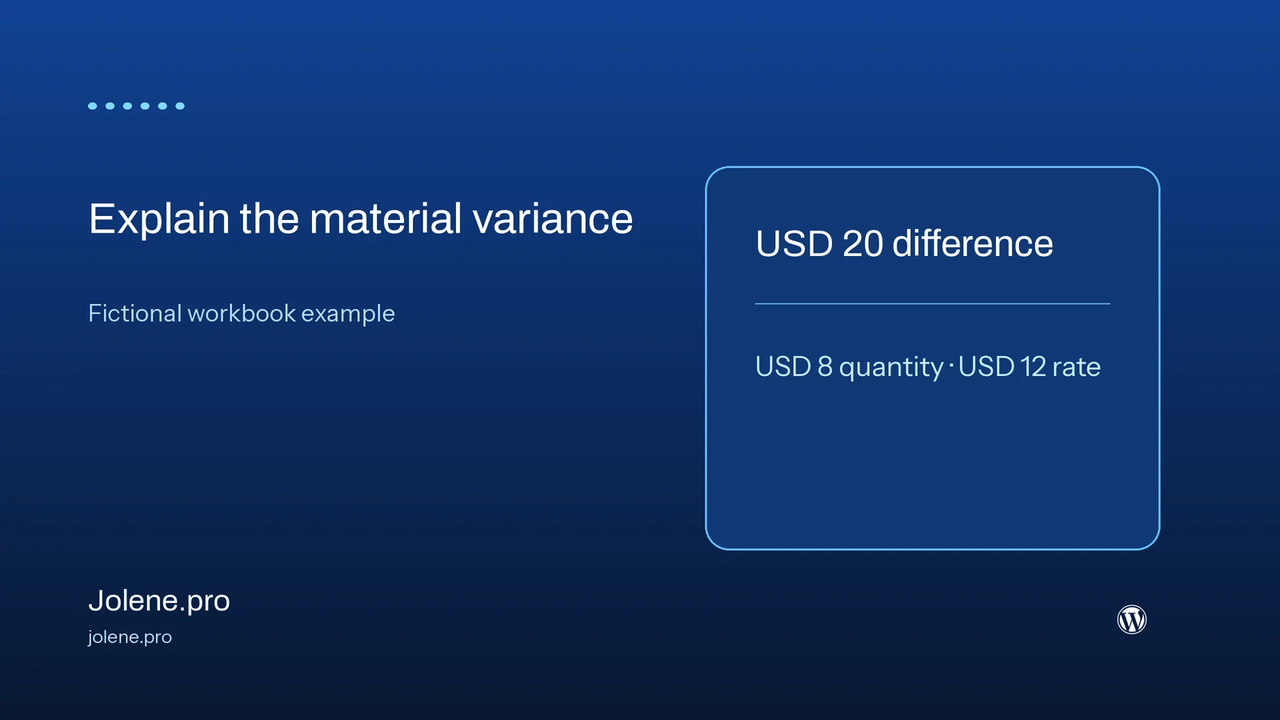
For this fictional component, the stock entry costs USD 60 and the bill of materials estimates USD 40. Under the comparison shown below, USD 8 comes from using more material and USD 12 from a higher unit rate.
Fictional records
| Batch | Component | Quantity | RateUSD |
|---|---|---|---|
| B1 | P1 | 10 | 4 |
| Batch | Component | Quantity | RateUSD |
|---|---|---|---|
| B1 | P1 | 12 | 5 |
What to check
- Select the same batch output and component. Verify assembly level, warehouse, units, currency and BOM revision. Record the rate source shown in each system.
- Multiply the quantity difference by the planned rate. Here, (12 − 10) × USD 4 = USD 8.
- Multiply the rate difference by the recorded quantity. Here, 12 × (USD 5 − USD 4) = USD 12. Add both amounts and compare with the recorded less planned cost.
Worked result
BOM!C2:D2 gives USD 40. Stock!C2:D2 gives USD 60. The two effects sum to USD 20. Hold unmatched components and undocumented unit conversions before calculating. The check explains the variance arithmetic for this component. Establishing its operational cause requires separate evidence.