Which affiliate transactions refer to the same shop order?
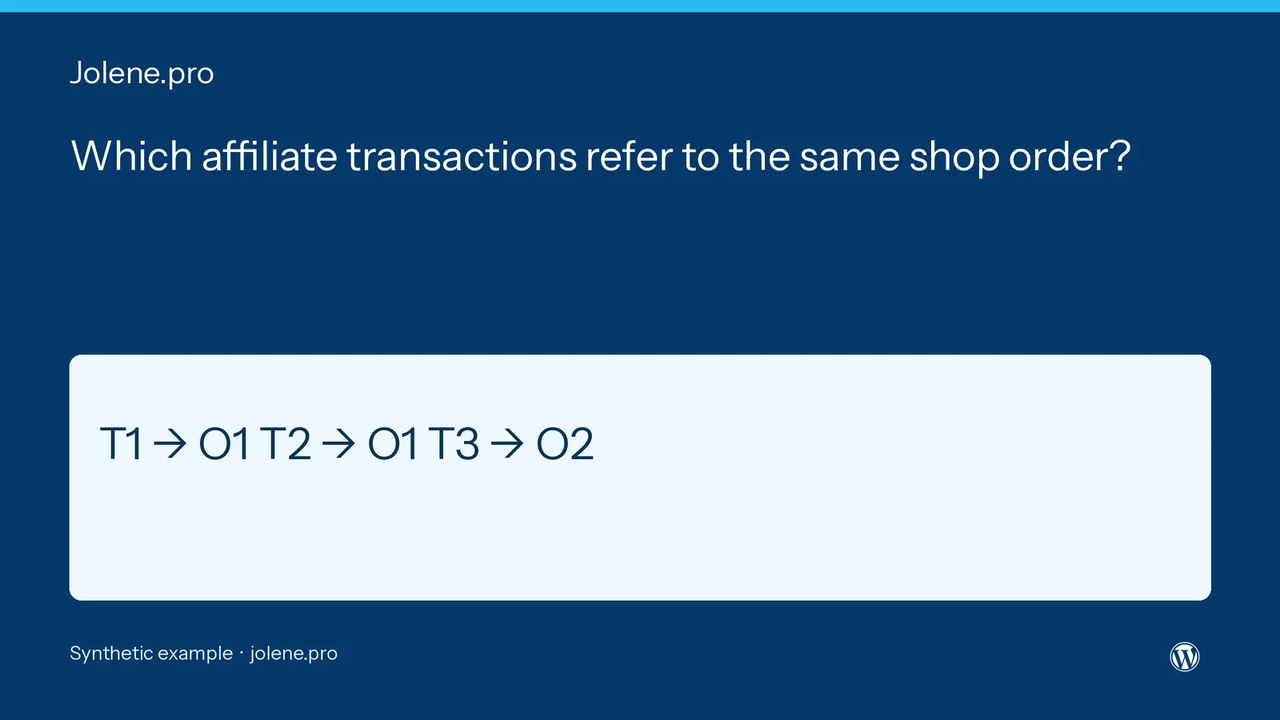
Three affiliate rows link to two distinct shop orders. O1 has T1 and T2 for review. T4 lacks a reference and O3 has no matched affiliate row in scope.
This example uses synthetic records and was independently checked. A live Jolene.pro result for these exact rows remains unverified.
Copy the example records
Copy each table to its named worksheet with row 1 as headers. Keep the original records alongside the comparison.
Affiliate!A1:B5
| Txn | Order |
|---|---|
| T1 | O1 |
| T2 | O1 |
| T3 | O2 |
| T4 | (blank) |
Shop!A1:A4
| Order |
|---|
| O1 |
| O2 |
| O3 |
Run the records check
Use a verified shop-plus-order key over a common date range. Group Affiliate!A2:B3 under O1, retain trusted event types and statuses separately, and validate unique shop order keys before counting. A shared order reference alone cannot establish an incorrect commission or causal attribution.
Check that Shop contains one record per shop and internal order ID. Retain each affiliate transaction ID and its event type. Count linked shop keys after matching, while listing multiple affiliate events against one key. The example retains both T1 and T2 so a reviewer can inspect their meanings.
Review exceptions before closing
Replies already propose reconciling separate exports. Show how to count distinct linked shop orders while preserving every source affiliate event for review. Shopify and Awin practitioner question.
Retain the reporting period, match keys, missing records and source row references with the result. Repeat the check after confirming corrections in the original system.