How to Calculate a Controllable Expense Cap in a CAM Reconciliation
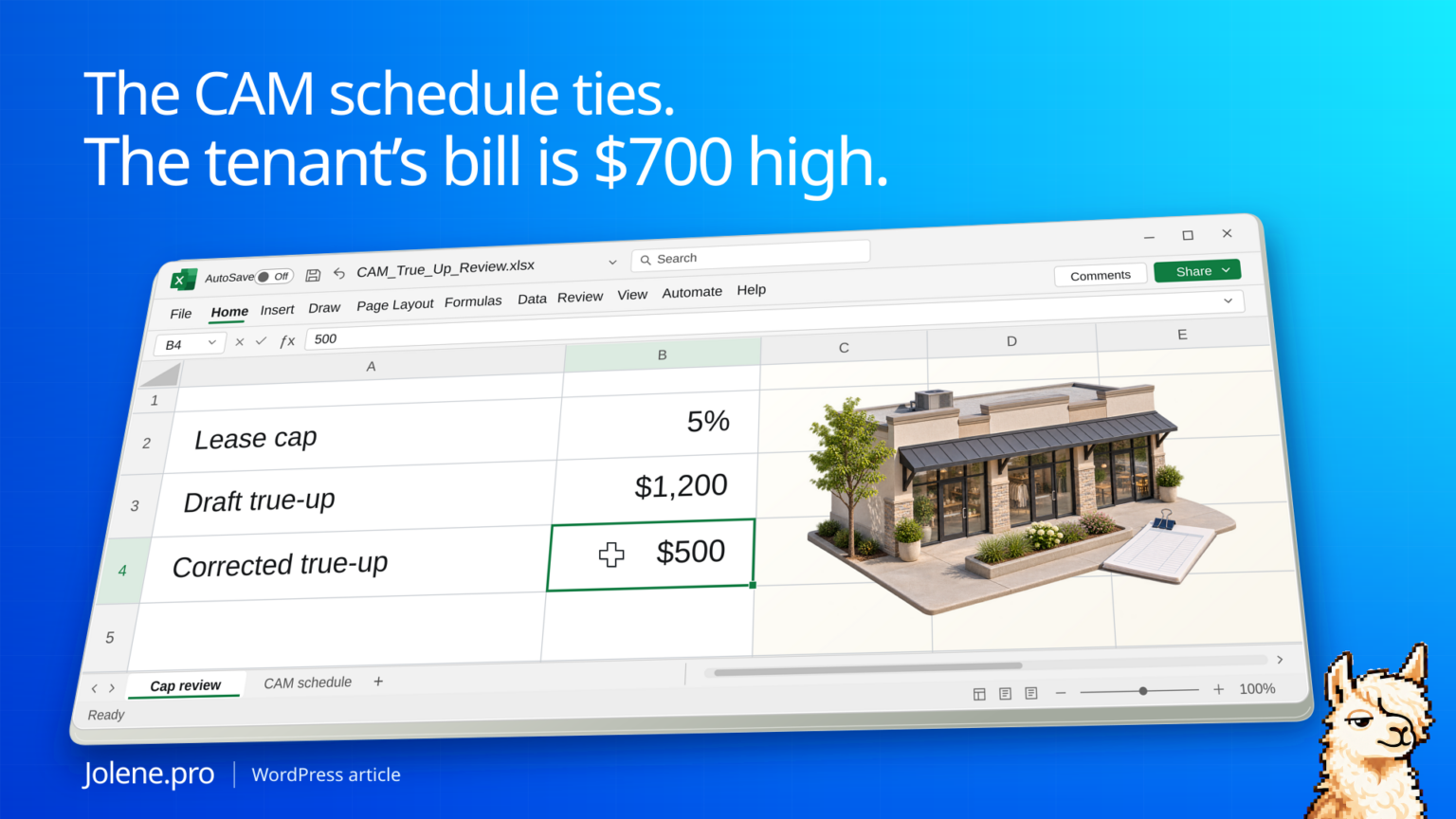
Every expense made it into the CAM schedule. The tenant’s statement is still $700 high. The workbook applied the tenant’s share to the actual ledger total before checking the limit on controllable costs.
Create a lease-specific calculation that applies the agreed cap to the eligible expense pool, then calculates the tenant’s share and subtracts estimates already billed. Use the approved terms for the base, exclusions and calculation order.
Try the cap on a sample tenant reconciliation
Download the CAM cap practice workbook (.xlsx)
The synthetic Expense Ledger has $112,000 in controllable expense and $30,000 in uncapped expense. 'Lease Terms'!B2:B5 holds the $100,000 prior allowable pool, 5% cap, 10% tenant share, and $13,000 in estimates already billed.
Check Reconciliation!B8:B15 for the $105,000 cap and the $500 true-up. Compare that to the $1,200 draft without the cap. Change the cap input in a copy of the workbook to see how it flows through to the statement. Use the approved terms for any real reconciliation.
| Result | Amount | Source |
|---|---|---|
| Controllable pool allowed under the cap | $105,000 | Lease Terms!B2:B3 and Expense Ledger!C2:D6 |
| Tenant true-up without cap | $1,200 | Expense Ledger!C2:D6 and Lease Terms!B4:B5 |
| Tenant true-up with cap | $500 | Lease Terms!B2:B5 and Expense Ledger!C2:D6 |
Try this question. Using the Lease Terms and Expense Ledger tabs, calculate the tenant’s CAM true-up, show the controllable and uncapped expenses, and cite the source cells for the cap and the balance.
Open Jolene.pro to run the example · Browse more Jolene.pro Workbook Studies
A $700 difference from one lease clause
Assume a sample lease with a 5% non-cumulative cap based on the prior year’s allowable controllable expense, a 10% share, and $13,000 of estimates already billed.
| Expense or billing input | Amount |
|---|---|
| Prior allowable controllable expense | $100,000 |
| Current controllable expense | $112,000 |
| Current uncapped expense | $30,000 |
| Tenant share before estimates, with cap | $13,500 |
| Tenant share before estimates, without cap | $14,200 |
The cap limits the controllable pool to $105,000. Add $30,000 of uncapped expense, then apply the 10% share. With $13,000 in estimates billed, the sample tenant owes a $500 true-up. Using all actual costs would produce $1,200.
Create a lease rules tab
Record the approved cap percentage, cap type, base year or prior-year basis, eligible expense accounts, recovery pool, share, and period. Link each rule to the lease schedule or approved interpretation. A cumulative cap can carry forward capacity under some terms. Handle that calculation explicitly if it applies.
Reconcile the result back to the statement
For the simple example, use MIN(CurrentControllable,PriorAllowable*(1+CapRate)) for the capped pool. Keep exclusions and uncapped lines visible. Check the expense total, tenant share, and estimates already billed before adjusting a true-up.
Review the proposed true-up lease by lease
Put approved lease inputs, expense detail, and the current billing schedule on separate tabs. Use preapproved rules for the calculation.
Using the lease rules tab, recalculate the tenant CAM true-up. Show controllable and uncapped expenses, how the cap was applied, estimates billed, and the source cells for each difference.
Review each difference alongside the approved rule and make the billing decision through your normal sign-off process.
Lowndes on cumulative and non-cumulative CAM caps · ABA overview of operating expenses
This is a synthetic calculation example. Confirm the actual lease language and approved accounting treatment before billing.
Try this with your own spreadsheet at Jolene.pro. Follow Jolene.pro on LinkedIn for more spreadsheet guides.